Part 6: Ruby Tuesday in the La Rochelle area
|
|
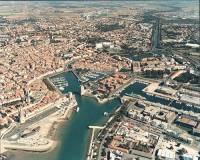
La Rochelle is a pretty city at ground level and the architecture is wonderful,
OK much of it is very simple and it is all quite unspoiled, but its only an air
shot that can show the extensive nature of the nautical heritage.
We took delivery of Ruby on Tuesday 2nd August and agreed to be off the professional
pontoon by weekend. But before we rafted Mithril along side and commenced the change
over we had the official test-sail or hand-over sail. Quite simply this was our
chance to find out what all the bits of string did, what our sail modifications
looked like, how they worked, etc etc.
Official test sail. The wind was force 2/3 so good for familiarisation.
First thing we noticed was how heavy the mainsail was but with Chris sweating it
up (yeah its a real sailing term) and me on the winch, up it went. We decided to
"pop a reef in the main" to slow us down and get us familiar with the
13 bits of string entering under the spray hood. We eventually had only a scrap
of headsail and 2 reefs in the main and still we estimated 5+ knots. Estimated?
Well the electronics had yet to be calibrated as I'd said I'd do it later and so
allow more time for sailing items.
We ended the afternoon with big smiles on our faces even though we had a list of
some 10 items needing sorting, one disconcerting item was that the auto pilot kept
dropping into standby without warning. One to watch! Oh yes and another thing, the
batons were proper limp wrist-ed. Another thing to check on.
After the test sail we put Mithril alongside Ruby so that we could begin the transfer
early on the morrow.
During Wednesday (3rd) we transferred all of the thing destined for the forward
cabin. This amounted to our entire clothes and shoe wardrobe together with some
quite heavy items due for storage beneath the double berth (bed) included sails
and sewing machine. We also filled the front water tank with 190 litres (and
that's 190 Kg). Then, mid afternoon, Chris arrived and asked why we where 6 inches
lower at the front than the back and why we listed 20 degrees to port. I was actually
quite concerned but laughed it off as early loading which was perhaps ill thought
out. Anyway on Thursday (4th), during the ongoing transfer, we just about gained
an even keel although our bum was still a little high in the air. On Friday
we had transferred everything, we cleaned the boat and readied ourselves for the
evening when Steve and Pam from White Night and Chris joined us for
a boat warming / moving-aboard celebration. That night we slept aboard Ruby;
we felt like royalty. During those last few days Cap Atlantic the Dufour agents
had sorted out the snagging list. The following week we fitted the Hydrovane, fitted
the electronics, organised the cockpit locker's stowage and bought a life-raft.
Hmmm what an ordeal that was.
|
|
The Liferaft Saga
One of the downsides to having a French flag is that we need to carry everything
specified on a safety list. The list includes 6 harness' and 6 life jackets even
though we sail as a twosome, but worst of all is the life-raft requirement. We had
a 5 person life-raft which I suppose was due a service so I strapped it on the cross
bar and cycled around he district looking for someone to service it. No chance.
It seemed that the life-raft must be registered in France, possess a service history
book, have sufficient food and water within it to sustain the entire crew off shore
for 3 days, have oars and a host of other kit. Clearly we needed to
buy one as the old one was deficient in about 90% of the items.
Checking Yachting Monthly's recent evaluation of rafts guided me towards a cheap
Plastimo one so off we cycled to "Big Ship", a chandlers local to us,
to buy one. The Madam in charge, who by now knows us quite well, put us straight,
none of that cheap crap is allowed in France from October this year. She even phoned
Plastimo France who advised similarly.
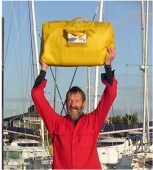
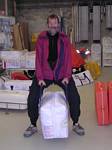
Big problem was that all the legal offerings weighed over 50 Kg and I could not
imagine pulling 50 Kg across the deck and throwing it astern. I straddled one in
the shop and could just lift it, for anyone to believe it launch-able they must
be a loony. You see here a comparison.
Anyway, Chris phoned around and found a reasonably priced one for us, but it still
weighed 50 Kg so he offered one of his staff and a van to help carry it to Ruby.
We lifted it out of the van, set off walking but within 20 yds both sewn-on tape
handles came off, ripping the valise. A second one was sent to a local sail-maker
for the handles to be reinforced before we took it away the following day. OK so
now we are legal, £1000 worse off and we have a liferaft neatly stowed beneath
the helm position. We think we might keep the old one for actual emergencies and
the new immovable one to keep us legal. What a joke. The only upside is that the
boat is now level.
|
|
|
Wow! Voile Magazine is at the newsagents. And Mithril is on centre fold and
a total of 7 full pages. Its a great review with superb photos and a computer
created inside view of the whole boat, no wonder Bernard took 150 photos.
Saint-Martin de R� , (15th Aug, 11 miles)
|
|
David, our eldest son, had arrived 2 days previously and so joined us on our first
voyage.
The passage to St-Martin. We motored out into the bay and spent an hour or
so traveling in circles calibrating the compass and the auto-pilot, then whilst
testing the auto tack feature, we tacked just as a catamaran had gone past and we
ran over his fishing line snapping it and wrapping it around the prop. The
resultant vibration put paid to further testing and so with full sail aloft we sailed
in light NW winds under the bridge and up the East side of the Ile de R� to Saint-Martin
de Re. Once the lock gates had closed, meaning no further movement of vessels was
likely within the marina, I went over the side with a bread knife to cut off
the fishing line. The line turned out to be about 10m long and of 1.5mm nylon and
needed wire cutters to shift. Lesson learned; don't pass too close to the stern
of other vessels as they might be fishing.
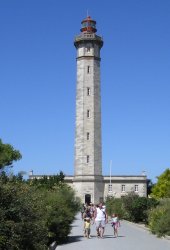
We had two days on the island and on the first we cycled to the North of the island
to see the salt pans, wildlife areas and the 57m tall Phare du Baleine. Its quite
amazing the time and effort which must have gone into the building of the huge number
of lighthouses (Phares) around France because they really are splendid structures,
particularly this one which is one of the tallest. Click the picture to see it a
little larger.
|
|
|
Cost: �38/day, water, electricity and showers all free.
Sable D'Olonne (17th Aug, 33 miles)
With the lock gate not opening until 1300 David spent the morning wandering around
the town. He went up the church tower in the centre of town and was stuck their
as the clock struck and chimed 12 o'clock. He said it was "$£#@!%"
loud" but to descend would mean passing within inches of the bells so he stayed
at the top.
Passage to L' Sable, exerts from the log.
- 1300 motoring out through the lock gates
- 1430 Hot and windless
- 1500 NW F1 (true) full sail and 4 knots
- 1600 little wind but its on the nose, 5 knots now though
- 1730 amazing progress in such light winds.
- 1915 tied up by capitainerie
Ile D'Yeu - Port Joinville (18th Aug, 39 miles)
We left La Sable at 1000 and at LW, such bravery now we have a shallow keel. The
passage was expected to be about 35 miles and we had about 9 hours before the tide
would be too low to enter Port Joinville. Winds would be NW 2-4, so on the nose.
The passage. We set off in light winds so had to motor out to sea and west
around the light house Les Barges, and it was here we found ourselves in a fleet
of 35 ft racing boats. All were sailing, of course, but only at about 2 knots. We
shut down the engine and joined in, David taking the opportunity to sort out the
fishing gear as the speed was ideal for a bit of mackereling.
After a couple of hours we found ourselves mid fleet and going well in the rising
wind and pointing up to about 35 degrees to the wind whereas the boats in front
were at maybe 30. David having already caught supper.
Through the afternoon the wind continued to rise until at about 20 knots we took
in the first reef. It was a bit late really but it made the passage more comfortable.
This was not for the racers who game-fully held full sail even though some were
almost laid flat in the water. We tacked closer to the island but found quite a
strong adverse tide so headed out again. By 1800 the sea was building and although
we were still going really well, apart from occasional slams that is, we decided
to motor the last 8 miles because the starboard tack had an adverse tide and the
port tack took us away from the destination, and anyway time was looking quite tight.
We tied up at 1900 after almost 40 miles.
We learned a lot about Ruby on the passage, particularly when to reef, although
next time we'll try reefing the headsail first as its a smaller increment whereas
the first reef in the main is a huge reduction. I'm not sure Dufour/Elvstrom got
this right.
|
|
Ile D' Yeu is a smashing island, as maybe you've read following our earlier visit
with Tomboy and Hitrapia.
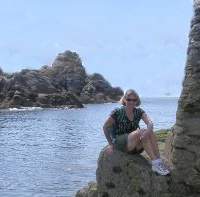
We had a few days on the Ile and on the first day we walked across the island to
the fishing harbour of La Meule. Just beyond the harbour is the rocky southern coastline
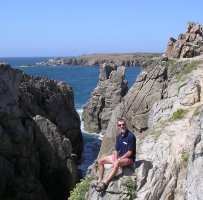
where David took these two photos. For the avoidance of doubt, Janet is on the left
and Barry is in the photo on the right.
|
|
|
Les Sable D'Olonne (21st Aug, 38 miles)
Another days of light winds saw us motor out of the harbour at about 0915, we were
fully expecting to motor the whole passage to Les Sable.
|
|
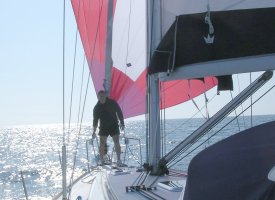
The passage. We motored North out of the harbour and 2 miles later turned
East, we hoisted full sail but kept the engine on as the wind was really light.
Frustration soon lead us to try our cruising chute, an asymmetric spinnaker, as
it would help pass the time. This sail is a poor mans down wind sail but much easier
to handle than a full blown spinnaker. It was not a perfect fit, being a little
long in the luff and originally designed for Mithril, but up it went and much to
our surprise it filled immediately and started pulling like fury. We stopped the
engine but still we had 5 knots showing on the log; we were impressed.
During the next few hours the wind rose slowly to touching a F4 directly behind
us, but keeping it on the quarter saw our speed move ever upwards. David and I took
up positions behind the wheel so we could watch the log, actually our eyes were
glued to it. We recorded a top speed of 8.9 knots and it felt like Ruby could do
12+ with no drama. Down below Janet shouted up to ask what we were doing but we
kept the speeds to our selves and smiled at one another.
Once we had a proper F4 (and maybe it was an F5) we took down the chute to try goose
winging dead down wind and still we did 7+ all the way to the harbour. It was one
passage we didn't want to end.
The following day we strolled around town and chose a restaurant for the evening.
We had a splendid meal, thanks David, and we left the restaurant at about
2300 straight into the evening festivities the French sea side towns seem to specialise
in. Jugglers, musicians, craft stalls, and all the bars still open so we sat and
had a night cap before heading home on the cross river ferry at about 0100.
As we'd had a few lazy days, after all that's what sailing is, we decided on a cycle
ride up the coast traveling North. Trouble was we only had 2 bikes so off into town
I cycled to try and find a Location Velo . 10Km later and only �8 lighter in the
purse I set off back through the busy town centre riding my Brompton and steering
the other via its saddle. Most of the traffic seemed surprised and allowed me right
of way, so much so, I was back in about 15 mins.
We had a great ride of about 45 km, mostly through woodlands and across salt pans.
We took lunch with us and sat on the beach and feasted.
|
|
Return to top
|
|
|
|

)
)